
Single Column Resume Format: A Simple Layout That Gets Your Resume Noticed
Explore the single column resume format, its benefits, structure, and examples. Create a professional, ATS-friendly resume for your next job.
Sujata Agarwal
Founder, DataShastri & Prepico
Key Takeaways & Highlights
Explore the single column resume format, its benefits, structure, and examples. Create a professional, ATS-friendly resume for your next job.
Introduction
Creating a professional resume is one of the most important steps in your job search. Whether you are applying for your first job or looking for a better career opportunity, your resume should communicate your qualifications, professional experience, and achievements clearly. However, many job seekers focus too much on decorative designs and complicated layouts, overlooking the importance of readability. This is where a single column resume format becomes a practical choice.
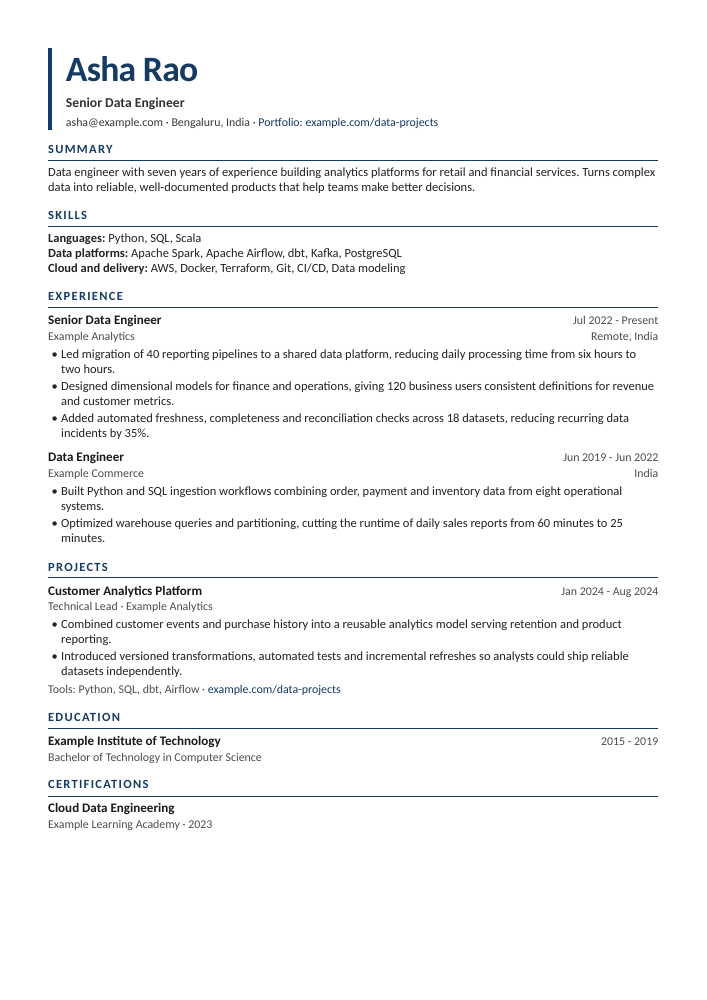
A single-column layout presents all your professional information in one continuous vertical structure. It allows recruiters to follow your career journey without navigating multiple columns, sidebars, or complicated design elements. It also helps applicant tracking systems (ATS) identify important information more consistently when the document uses standard headings and readable formatting.
For candidates applying across different industries in India, a simple and organised resume can make a positive first impression. With the right content, formatting, and keyword placement, a single-column resume can communicate your professional value effectively.
What Is a Single Column Resume Format?
A single column resume format is a resume layout in which all sections are arranged vertically in one main column. Instead of dividing the page into separate sections on the left and right sides, this format follows a straightforward reading sequence from top to bottom.
The layout generally begins with your name and contact information, followed by a professional summary, skills, work experience, education, certifications, and additional qualifications. Each section receives a clear heading, making it easier for recruiters to locate relevant details.
Unlike heavily designed resumes, a single-column structure prioritises content over decoration. It uses consistent fonts, appropriate spacing, bullet points where necessary, and simple formatting to maintain readability. This makes it suitable for job seekers who want their qualifications to remain the central focus of their applications.
Why Is a Single Column Resume Format Important?
Recruiters often review numerous applications for a single vacancy. A resume that communicates information clearly can make their evaluation process easier. A single column resume format creates a predictable reading flow, allowing hiring managers to understand your professional background without unnecessary visual distractions.
Another important advantage is compatibility with applicant tracking systems. Many ATS platforms extract information from uploaded resumes to organise candidate profiles. Although no layout guarantees perfect ATS parsing across every platform, a simple, text-based, single-column document generally reduces potential reading issues associated with complex layouts, text boxes, graphics, and multi-column structures.
This format also offers flexibility. Candidates can adjust their professional summary, skills, and experience sections according to the requirements of different job applications without redesigning the entire document.
Ideal Structure of a Single Column Resume
An effective resume should contain relevant information arranged in a logical order. The following table explains the recommended sections and what to include in each one.
Resume Section
Information to Include
Purpose
Contact Information
Name, phone number, professional email, LinkedIn profile
Helps recruiters contact you
Professional Summary
Experience, key strengths, career achievements
Introduces your professional profile
Key Skills
Technical skills, industry knowledge, soft skills
Highlights relevant capabilities
Work Experience
Job titles, company names, employment dates, achievements
Demonstrates professional experience
Education
Degree, institution, graduation year
Shows academic qualifications
Certifications
Relevant courses and professional certifications
Demonstrates additional expertise
Additional Information
Languages, projects, relevant accomplishments
Provides supporting information
Each section should have a clear heading and consistent formatting. Your most relevant qualifications should appear early in the document so recruiters can identify your suitability quickly.
| Resume Section | Information to Include | Purpose |
|---|---|---|
| Contact Information | Name, phone number, professional email, LinkedIn profile | Helps recruiters contact you |
| Professional Summary | Experience, key strengths, career achievements | Introduces your professional profile |
| Key Skills | Technical skills, industry knowledge, soft skills | Highlights relevant capabilities |
| Work Experience | Job titles, company names, employment dates, achievements | Demonstrates professional experience |
| Education | Degree, institution, graduation year | Shows academic qualifications |
| Certifications | Relevant courses and professional certifications | Demonstrates additional expertise |
| Additional Information | Languages, projects, relevant accomplishments | Provides supporting information |
How to Create a Resume Format for Experienced Professionals?
A resume format for experienced professionals should focus on career progression, measurable achievements, leadership abilities, and specialised skills. Unlike entry-level resumes, experienced candidates need to demonstrate how their contributions have created value for previous organisations.
Start with a professional summary that explains your experience, industry background, and major strengths. Avoid generic statements that could apply to almost any candidate. Instead, mention your specialisation, relevant tools, management experience, and professional accomplishments.
Your work experience section should follow reverse chronological order, beginning with your current or most recent position. Include your job title, organisation, employment period, and responsibilities. Wherever possible, explain achievements using measurable results such as revenue growth, improved productivity, cost savings, customer satisfaction, or successful project completion.
For example, instead of writing that you were responsible for managing digital marketing campaigns, explain how you managed campaigns that increased website traffic by 35% or improved lead generation. Specific results make your professional experience more meaningful and demonstrate your contribution.
| Feature | Resume for Freshers | Resume for Experienced Professionals |
|---|---|---|
| Professional Summary | Career objectives and relevant strengths | Experience and career achievements |
| Main Focus | Education, projects, internships | Employment history and results |
| Skills | Academic and technical skills | Industry-specific and advanced skills |
| Work Experience | Internships or training | Previous and current positions |
| Certifications | Relevant courses | Professional qualifications |
| Resume Length | Usually one page | Usually one or two pages |
Single Column Resume Format for Freshers and Experienced Candidates
The requirements of a resume differ depending on your career stage. Freshers generally need to highlight academic qualifications, internships, projects, technical knowledge, and relevant certifications. Experienced candidates should give greater importance to employment history, professional achievements, and specialised expertise.
A single-column layout can accommodate both requirements without changing its fundamental structure. Candidates can simply rearrange the sections according to their experience and the job description.
Feature
Resume for Freshers
Resume for Experienced Professionals
Professional Summary
Career objectives and relevant strengths
Experience and career achievements
Main Focus
Education, projects, internships
Employment history and results
Skills
Academic and technical skills
Industry-specific and advanced skills
Work Experience
Internships or training
Previous and current positions
Certifications
Relevant courses
Professional qualifications
Resume Length
Usually one page
Usually one or two pages
Choosing the right content is more important than adding unnecessary sections. Every detail should support your suitability for the position.
Best Practices for an ATS-Friendly Single Column Resume
A well-designed single column resume format should balance professional appearance with technical readability. Use standard fonts such as Arial, Calibri, or Aptos, and maintain a consistent font size throughout the document. Your name and section headings can be slightly larger to establish a clear visual hierarchy.
Use conventional headings such as Professional Summary, Work Experience, Skills, and Education. These familiar labels help recruiters understand the document structure and can support ATS information extraction.
Avoid placing important information inside images, decorative graphics, complex tables, or text boxes. Your contact details should appear in the main document body rather than only in headers or footers. Save your resume in the file format requested by the employer, whether PDF or DOCX.
Another important practice is keyword optimisation. Carefully review the job description and naturally include relevant skills, qualifications, tools, and industry terminology that genuinely reflect your experience. Do not overload the document with repeated keywords because this can make your resume difficult to read.
Common Mistakes to Avoid When Creating a Single Column Resume
Even a simple layout can become ineffective when the information is poorly organised. One common mistake is including lengthy paragraphs that make it difficult for recruiters to identify important achievements. Keep descriptions concise and focus on relevant responsibilities and measurable outcomes.
Another mistake is using inconsistent formatting. Different fonts, irregular spacing, unnecessary colours, and unclear headings can reduce the professional appearance of your document. Maintaining a consistent structure makes the resume easier to scan.
Job seekers should also avoid adding irrelevant personal information, outdated skills, and unrelated work experience. Instead, customise the resume according to the position and industry. Always review spelling, grammar, employment dates, and contact details before submitting your application.
Create a Professional Resume with Prepico AI
Building a professional resume does not have to be complicated. Prepico AI provides an accessible starting point for job seekers who want to organise their professional information and create a polished resume.
Whether you are a fresher preparing your first application or an experienced professional exploring new opportunities, choosing an organised resume structure can help communicate your qualifications more effectively.
A carefully prepared single column resume format allows you to present your career journey in a clear and consistent manner. Focus on relevant skills, measurable achievements, professional experience, and accurate information to make your resume more meaningful to recruiters.
Visit to explore resume-building options and work towards creating a job-ready professional profile.
Ready to Create an ATS-Friendly Resume in Minutes?
Join thousands of candidates who build job-winning, single-column resumes with Prepico. Export identical Microsoft Word and PDF files without hidden charges.
Frequently Asked Questions (FAQs)
A single column resume format is a professional resume layout where all information is organised vertically in one main column. It includes sections such as contact details, professional summary, skills, work experience, and education.